
Description
SAP C_C4H27_2609 Exam Guide: Preparing for SAP Engagement Cloud Certification
The SAP C_C4H27_2609 certification is designed for professionals who want to demonstrate their ability to support the implementation of SAP Engagement Cloud, enterprise edition. It focuses on applying product knowledge to practical implementation scenarios, making it relevant for aspiring consultants who need to understand both the solution and the stages of a customer project.
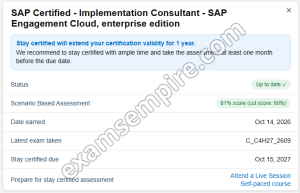
SAP’s official certification page currently lists the exam under the shorter code C_C4H27 and names it SAP Certified – Implementation Consultant – SAP Engagement Cloud, enterprise edition. Candidates should check the official page for the latest details before registering.
SAP C_C4H27 Exam Overview
| Exam detail | Information |
|---|---|
| Certification | SAP Certified – Implementation Consultant – SAP Engagement Cloud, enterprise edition |
| SAP-listed exam code | C_C4H27 |
| Assessment format | One scenario-based activity |
| Duration | 2 hours |
| Passing score | 60% |
| Intended level | Novice implementation consultant |
SAP states that previous project experience is not a prerequisite. The certification assesses whether candidates understand the product and can apply their knowledge to plan and implement it in a mentored role.
What Is SAP Engagement Cloud, Enterprise Edition?
SAP Engagement Cloud, enterprise edition is a customer engagement solution. For an implementation consultant, understanding the product means more than knowing its features: it also means being able to connect business requirements with implementation decisions.
For example, a customer may operate across several regions or brands and need a consistent approach to customer engagement. A consultant must understand the customer’s objectives, consider how the organization will be structured, and work with the project team to plan, test and launch the solution.
Who Should Take the C_C4H27 Exam?
This certification may be useful for:
- Aspiring SAP implementation consultants.
- SAP Customer Experience professionals expanding their product knowledge.
- Project team members involved in customer engagement implementations.
- Business analysts who work with customer requirements and solution design.
- Consultants preparing to support SAP Engagement Cloud projects in a mentored role.
While prior project experience is not required, familiarity with cloud applications, business processes and implementation projects can help you understand the scenarios you study.
Key Areas to Study
Your preparation should start with SAP’s official certification page and its recommended learning resources. Build your understanding around the product and the implementation lifecycle, then practise explaining how you would apply that knowledge to a customer situation.
1. Product Features and Architecture
Learn the purpose of SAP Engagement Cloud, enterprise edition and the capabilities it provides. Pay attention to its API-first architecture and omnichannel features, and consider how these support a customer’s engagement requirements.
As you study, ask yourself:
- What business need does a feature address?
- Which teams or users would be involved?
- What information might need to move between systems?
- What should the implementation team confirm before proposing a solution?
2. Business Areas and Governance
Review how business requirements, organizational structures and governance influence an implementation. A company operating multiple brands or regions may need clear decisions about ownership, responsibilities and how its engagement activities are organized.
Practise describing the questions you would ask stakeholders before recommending an approach. Consider both the business requirements and the practical implications for the project team.
3. Implementation Planning and Account Setup
An implementation begins with understanding the customer’s objectives and preparing the foundation for the project. Study the activities associated with planning and account setup, including the information a team needs before moving into detailed design.
A useful preparation exercise is to outline the initial steps for a fictional customer: identify stakeholders, clarify the project scope and document assumptions that need confirmation.
4. Analysis, Design and Technical Development
During analysis and design, consultants translate business needs into a workable implementation approach. Review how requirements are gathered and assessed, and how design decisions are handed over for technical work.
For scenario practice, focus on explaining why you would recommend a particular next step. If a requirement is unclear, identify the information you would need before making a decision.
5. Testing, Go-Live and Hypercare
A successful implementation requires more than completing the initial setup. Study how the project team checks whether the solution meets agreed requirements, prepares users for go-live and responds to issues after launch.
Understand the purpose of:
- Testing: Checking processes and identifying issues before launch.
- Go-live: Moving the agreed solution into operational use.
- Hypercare: Providing focused support immediately after go-live.
These areas are useful for practising end-to-end scenarios, because a design decision made early in a project can affect testing and support later.
How to Prepare for the Scenario-Based Assessment
SAP lists C_C4H27 as a scenario-based assessment, with one activity to complete in two hours. Its certification page also provides resources to help candidates become familiar with the assessment experience.
A practical study approach is to:
- Review the official learning material. Build a foundation in the product, its architecture and the implementation process.
- Create short customer scenarios. For example, consider a business introducing the solution across two regions with different stakeholder requirements.
- Explain your response aloud. State the issue, the information you need, your proposed next steps and the reason for your approach.
- Connect project stages. Consider how decisions made during analysis and design affect development, testing and go-live.
- Check your technical readiness. SAP provides a technical readiness checklist and assessment preparation resources on the certification page.
When responding to a scenario, avoid relying only on memorized definitions. Show that you understand the customer’s situation and can explain a sensible implementation approach.
Example Practice Scenario
Scenario: A company wants to introduce SAP Engagement Cloud, enterprise edition across multiple regions. The regional teams have different requirements, and the project team has not yet agreed on responsibilities.
How to approach it:
- Identify the customer’s overall business objectives and the requirements of each region.
- Meet the relevant stakeholders to clarify decision-making and project responsibilities.
- Review how the proposed organizational and governance approach supports the requirements.
- Document open questions and assumptions before finalizing the design.
- Plan how the agreed processes will be tested before go-live.
This is an original study example, not an SAP exam question. Its purpose is to help you practise organizing and explaining your thinking.
Frequently Asked Questions
What is the full name of the SAP C_C4H27 certification?
SAP lists the certification as SAP Certified – Implementation Consultant – SAP Engagement Cloud, enterprise edition.
How long is the C_C4H27 assessment?
SAP currently lists a duration of two hours.
What is the passing score?
The passing score shown on SAP’s certification page is 60%.
Is prior SAP project experience required?
SAP says previous project experience is not a prerequisite. The certification is intended to validate the knowledge and practical skills of a novice implementation consultant working in a mentored role.
How can I register for the certification?
Visit the official SAP certification page and review the current requirements. SAP advises candidates to check their SAP Universal ID, Learning Hub subscription and available certification attempts before starting.
What is the best way to study?
Start with SAP’s recommended learning resources, then use realistic scenarios to practise applying what you have learned. Focus on explaining implementation decisions and the reasons behind them.
Reviews
There are no reviews yet